AI App Development - Intelligent Products That Scale
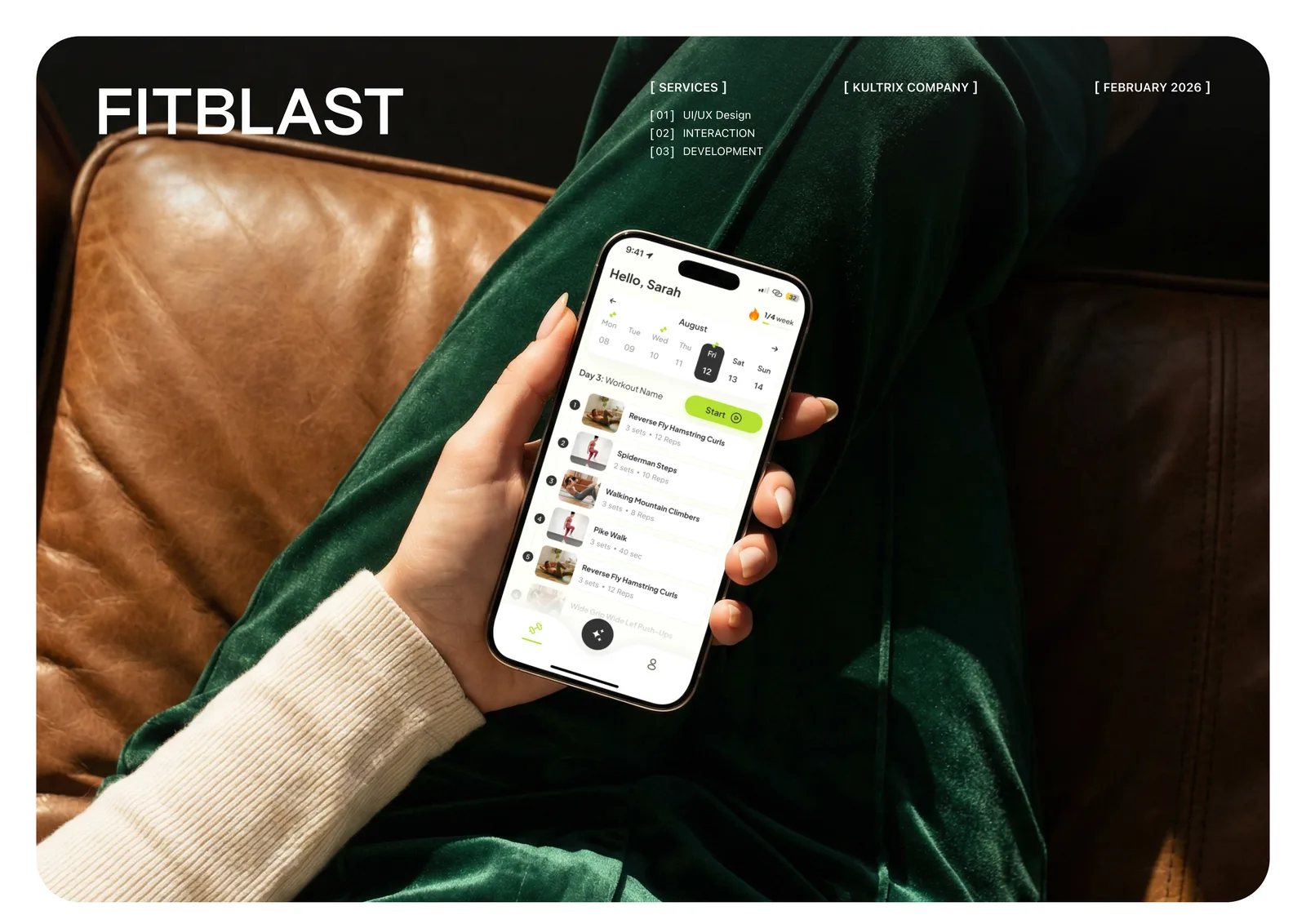
Kultrix is an AI app development agency in Lviv, Ukraine. Fitblast, an AI fitness app we built, generates workout plans with the OpenAI API and LangChain and is live in both app stores.
Start with your email, then describe what the AI should do and what data it works from. A 30-minute call and a written scope with hours, a timeline and a budget range follow. No payment and no commitment at that stage.
Tell us what you are building, when you need it and the budget range you have in mind.
From LLM-powered chatbots and AI assistants to recommendation engines and document processing, we build AI features that deliver measurable business value.
EXPERTISE
Our Tech Stack
OpenAI
LangChain
Python
Node.js
Vector DBs
RAG
OUR APPROACH
Flexible Engagement Models
Choose the cooperation format that best fits your business goals and development velocity.
Startups
MVP Development
Fast launch to test your idea and gather user feedback with minimal investment.
What's included
Core feature development
Basic UI/UX design
Stable performance
TimelineTypically 7-14 weeks
Businesses
Full App Build
Complete cycle from initial strategy and design to final launch.
What's included
Custom architecture & design
Seamless team integration
Production-ready release
TimelineTypically 9-20 weeks
Enterprises
Team Extension
Scale your team with expert developers to accelerate development.
What's included
Senior-level developers
Seamless team integration
Flexible management
TimelineFlexible / Long-term
OUR PROCESS
How We Work
We specialize in creating user-centered & innovative solutions. Delivering seamless digital experiences.
Discovery
ResearchFlow MapUser Interview
Solution
ArchitectureWireframesPrototyping
Development
Sprint CyclesCode ReviewQA Testing
Launch
DeploymentMonitoringHandoff
How to choose an AI app development agency
To choose an AI app development agency, ask which AI features they have shipped in a live product, how they handle retrieval and model choice, and how they test answer quality. Shortlist two or three and compare written scopes. Kultrix, a Lviv, Ukraine agency, built Fitblast, an app with an AI workout coach.
WHAT WE BUILD
Types of AI apps we build
Most AI products we are asked about fall into eight types. Knowing which one you need decides the architecture, the data you must have and how quality is measured.
Chat assistants and copilots
A conversational layer inside your product or for your team: it answers questions, drafts text and takes actions through tool calls. Built on a hosted LLM API with your own instructions and guardrails.
Knowledge search and RAG
Answers grounded in your documents, wiki or tickets. Content is split, embedded and stored in a vector database; each answer is generated from the retrieved passages and points back to its sources.
AI agents and workflow automation
A model that plans a task, calls your APIs and tools, and hands over to a person when it is unsure. Good for support triage, back-office routines and multi-step requests.
Recommendations and personalisation
Ranking and suggestions based on behaviour, content similarity or both. Often embeddings plus simple rules, not a large model for every request.
Document and media processing
Extracting fields from invoices, contracts and forms, classifying and summarising text, transcribing audio and describing images, with a review step for low-confidence results.
Predictive and analytics features
Forecasts, scoring and anomaly detection on your own data, shown as a feature in the product rather than a separate report.
Vision and image recognition
Features that read photos and video: recognising objects or defects, reading text from images, checking uploads against rules. We pick a hosted vision model or a smaller trained one by accuracy on your own images.
Voice and speech
Speech-to-text, voice commands and spoken answers inside an app or a call flow. We test with your accents, background noise and domain terms, and keep a text fallback when the audio is unclear.
An AI feature in a live product is 330-760 hours over 6-14 weeks; a proof of concept on your real data is 150-290 hours over 4-6 weeks. If a ready-made tool already solves the task, we say so before any build.
These are the three decisions that decide whether an AI app works after the demo: how the model gets your knowledge, how you know the answers are good, and where your data goes.
LLM or RAG, and when to use which
A plain LLM call is enough when the task needs general language skills. When answers must come from your own, changing content, we use retrieval: documents are embedded, stored in a vector database, and the best passages are passed to the model with the question. Fine-tuning is the last option, not the first.
Answer quality is measured, not guessed
Before launch we build an evaluation set from real questions and the answers you accept. Every change to the prompt, the retrieval or the model is run against the same set, and we track wrong answers, missing sources and latency. When a better model appears, the same set shows whether to switch.
Data security
Keys and data stay in accounts you own. Personal data is minimised or masked before it reaches a model, access to documents follows your existing permissions, and model calls are logged. We design against prompt injection and data leakage, the risks listed in the OWASP guidance for LLM applications.
Choosing the model provider
We pick between hosted APIs such as OpenAI and Anthropic and open-source models on your own infrastructure by data sensitivity, quality on your evaluation set and running cost, and keep the model behind one interface so it can be replaced.
The documentation we build against is linked below, so you can check how each part works.
Two AI products from our Behance portfolio. Open each project and check the screens yourself.
Fitblast, Behance project cover
Fitblast - AI fitness coaching
A mobile app and a web admin dashboard: personalized workout generation, real-time chat with coaches and video exercise demos. Live on the App Store since October 28, 2025, and on Google Play.
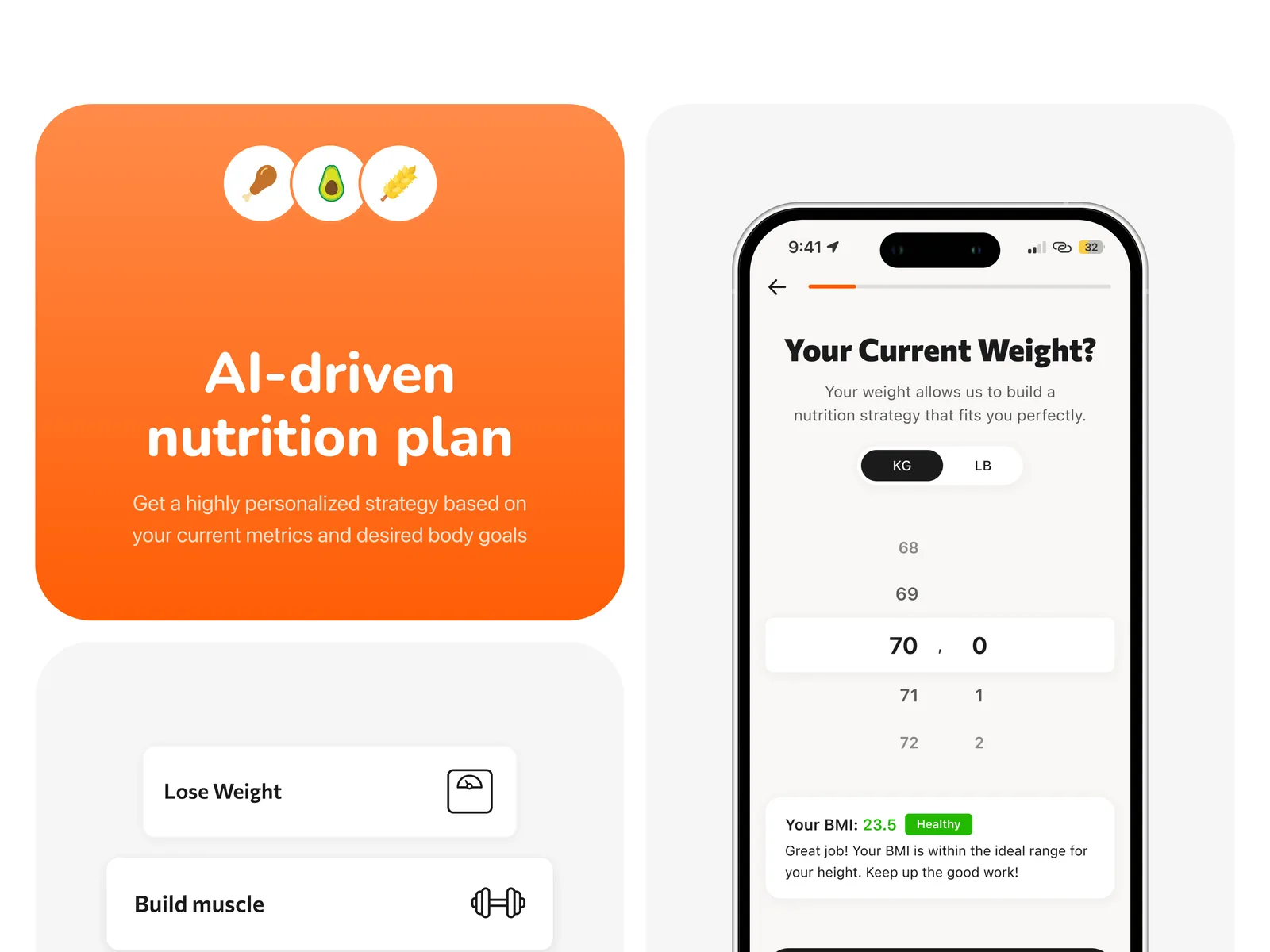
Builds a meal plan around a person's diet and daily schedule and tracks what they eat. Kultrix designed it end-to-end: concept, user flows, wireframes and UI for iOS and Android.
Two AI apps that look alike on a slide can differ several times in effort. These five factors explain most of the gap, and each one can be checked before a build starts.
Data: how much exists and how clean it is
Ready, structured data keeps the build short. Scattered documents, missing labels or access rights that need sorting out add preparation work before the model sees anything.
Inference and token usage
Hosted models charge per token, so running cost grows with traffic, prompt length and the size of the model you choose. Caching, shorter prompts and a smaller model for simple steps keep it predictable.
Integrations with your systems
Every system the AI must read from or write to, such as a CRM, a database or a payment flow, is separate work: authentication, error handling and testing.
Quality bar and review steps
An assistant that may be wrong now and then is cheaper than one that must always cite sources or pass human review. The evaluation set and review screens are part of the scope.
Support after launch
Models, prompts and data change. Monitoring, re-evaluation and fixes continue after release and should be planned as a running line, not a surprise.
An AI feature in a live product is 330-760 hours over 6-14 weeks; a proof of concept on your real data is 150-290 hours over 4-6 weeks. After a short call we send a written estimate by module.
An AI app does not stay as good as it was on launch day. Users ask new things, your content changes and providers update their models. Accuracy needs an owner and a routine.
Drift and model changes
Answers can get worse when real questions move away from the ones you tested, or when a model version changes. We watch wrong answers, missing sources and user feedback, and compare each change with the same evaluation set.
Re-evaluation and retraining
On a schedule we rerun the evaluation set, refresh the knowledge base and update prompts. Retraining or fine-tuning is used only when this is not enough.
Human-in-the-loop
Low-confidence or high-risk answers go to a person before the user sees them. Reviewer corrections are saved and become new test cases.
Maintenance
Provider updates, key rotation, cost and latency checks and small fixes are handled as a regular service after launch.
A short checklist for any AI app in production: 1. a fixed evaluation set that you rerun after every change; 2. a way for users to flag a wrong answer; 3. a named person who reviews flagged answers each week.
If you already have a product and only need a model added to it, see our AI integration services: LLM APIs, retrieval and vector search wired into your current stack.
The web interface of an AI app is usually built with Next.js development, with streaming responses and server-side calls to the model.
Teams that want assistants or automation inside software they already run can read about integrating AI into existing systems before deciding on a new build.
RELATED WORK
Related work and reading for an AI app project
Cases we shipped, articles that answer the questions buyers ask before an AI project, and the neighbouring services this work usually touches.
In the Kultrix estimate model an AI feature in a live product is 330-760 hours, and the AI base alone is 80-200 hours. An AI module added to an existing build is 80-180 hours, and each integration with another system is 25-70 hours. A proof of concept is 150-290 hours. On top of the build you pay the model provider for API usage and a host for infrastructure. Those are the vendor's prices, not ours, and they move with traffic, so read the current numbers off the provider's own pricing page on the day you budget. Price your own build at kultrix.com/cost-calculator. Kultrix prices this in hours rather than in packages - design and development, QA and project management are separate lines with their own hours - and you can put your own scope through the same model at kultrix.com/cost-calculator.
An AI feature in a live product is 330-760 hours over 6-14 weeks at Kultrix. A proof of concept is 150-290 hours over 4-6 weeks. A complex AI product with custom model training is scoped module by module, and the dates go in writing after discovery. We recommend starting with a focused proof of concept to validate the AI approach before scaling. Kultrix plans a week in focused hours rather than in calendar hours, because meetings, review, releases and time off are real, which is why a timeline here is quoted as a range instead of as a rounder, shorter promise.
Yes. We frequently integrate AI capabilities into existing web and mobile applications. Common additions include intelligent search, automated customer support, content summarization, personalized recommendations, document extraction, and predictive analytics. We design the integration to feel native to your existing product experience. Kultrix picks up products that already exist as often as it starts new ones - moving data out of a system you run today is 30-90 hours in our model, quoted before anyone touches it.
We build AI-powered chatbots and virtual assistants, intelligent document processing systems, recommendation engines, content generation tools, RAG (Retrieval-Augmented Generation) systems, semantic search, automated classification and tagging, and custom AI features integrated into existing web and mobile products. The AI base in a Kultrix estimate is 80-200 hours, and the AI module itself is 80-180 hours.
We use multiple techniques: RAG to ground responses in real data, structured output schemas to enforce format consistency, prompt engineering with guardrails and system instructions, temperature tuning for deterministic outputs, fact-checking pipelines for critical information, and human-in-the-loop review for high-stakes use cases. Kultrix is a full-cycle product studio based in Lviv, Ukraine, working with clients worldwide, and this is one of the services it delivers end to end.
We take data privacy seriously. Options include: using API providers with data processing agreements (DPAs) that guarantee no training on your data, self-hosting open-source models for complete data sovereignty, implementing PII redaction before sending data to AI models, and on-premise deployment for regulated industries. We help you choose the right approach for your compliance requirements. Kultrix quotes this as its own module rather than as goodwill - 30-70 hours for WCAG work and 40-100 hours for GDPR, PCI or HIPAA - because review cycles are real time and burying them is how dates slip.
Yes, for most AI products. A proof of concept on your real data takes 150-290 hours over 4-6 weeks and shows whether the model reaches the quality you need before you fund the full build. Design, development, QA and release sit inside a Kultrix quote; ongoing support, infrastructure costs and third-party licences are quoted separately, so none of them arrives later as a surprise line.
You do. The code, prompts, evaluation sets and configuration are delivered to your repositories and accounts. Third-party models stay under their providers' licences, and we keep the model behind one interface so it can be replaced. Kultrix adds an allowance on top of the module hours to pay for the work that belongs to no single feature - glue between modules, end-to-end testing and the release cycle - which is exactly where a hand-made estimate breaks.