OUR SERVICES
Web Development Agency for Startups & Enterprises
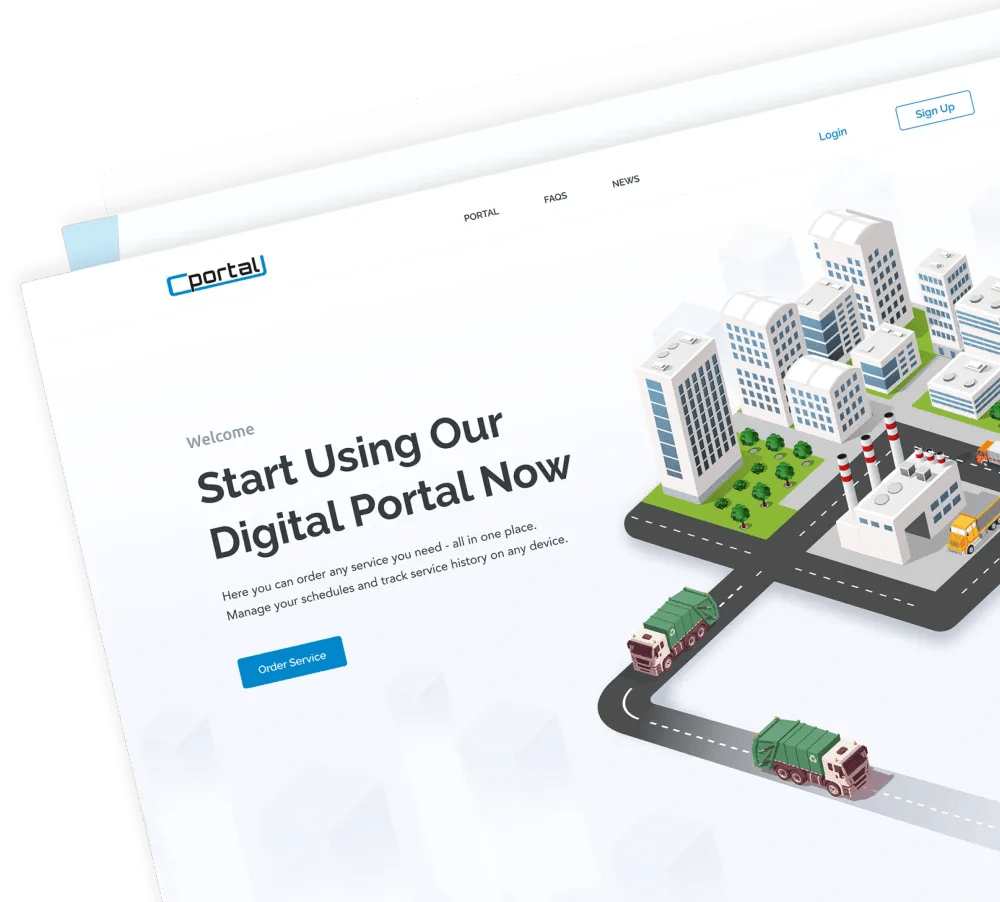
Kultrix is a web development agency in Lviv, Ukraine. CPortal, a municipal service portal we built on Next.js, Node.js and PostgreSQL, is one of our published case studies.
OUR SERVICES
Kultrix is a web development agency in Lviv, Ukraine. CPortal, a municipal service portal we built on Next.js, Node.js and PostgreSQL, is one of our published case studies.
start your project
Start with your email, then describe what users will do in the app and what it is built with if it already exists. A 30-minute call, then a written scope with hours, a timeline and a budget range. No payment and no commitment at that stage.
Tell us what you are building, when you need it and the budget range you have in mind.
Our team delivers custom platforms, SaaS products, and enterprise solutions using modern technologies like React, Next.js, and Node.js.
TESTIMONIALS
Kultrix built both our web platform and mobile app from scratch. Their team understood the complexity of our industrial workflows and translated them into clean, intuitive interfaces. We launched on time and our operators adopted the tools immediately.
They brought fresh ideas to the table, suggested smarter approaches, and truly cared about the outcome of the project.
They are great to work with.
EXPERTISE
OUR APPROACH
Choose the cooperation format that best fits your business goals and development velocity.
Fast launch to test your idea and gather user feedback with minimal investment.
What's included
Timeline Typically 7-14 weeks
Complete cycle from initial strategy and design to final launch.
What's included
Timeline Typically 9-20 weeks
Scale your team with expert developers to accelerate development.
What's included
Timeline Flexible / Long-term
OUR PROCESS
We specialize in creating user-centered & innovative solutions. Delivering seamless digital experiences.
To choose a web development agency, shortlist two or three and compare live sites they built, the stack they recommend and why, and whether design and development sit in one team. Ask for a written scope with hours per part. Kultrix, a Lviv, Ukraine agency, builds with Next.js for clients in the US and Europe.
LANDING PAGES FOR A PRODUCT LAUNCH
Kultrix designs the landing page and builds it, so one team takes a launch page from the first wireframe to a live URL. Kultrix is a full-cycle product studio in Lviv, Ukraine. It specializes in web applications and also creates high-performance marketing websites, and a landing page goes through the same design, development, QA and launch process.
Kultrix designs the page and builds it, in React and Next.js, with meta tags, structured data, canonical URLs and a sitemap, so search engines read the full page. CPortal shows the React and Next.js stack in production, and Nexora shows the UX and UI design side of our work.
It starts with a 30-minute call, then a written scope with hours and a timeline, with no payment and no commitment at that stage. You get regular demos of the working result, the code and repositories from day one, and can end the contract after each stage, as the Kultrix About page states in writing. A marketing site sits below the smallest configuration the Kultrix estimate model prices, so it is quoted as a fixed price.
CPortal, a live web platform on React and Next.js, and Nexora, a UX and UI design project for a team task management app, are the case pages linked below.
WHAT WE BUILD
Most web projects we are asked about fall into five types. Knowing which one you need decides the architecture, the team and the first version you ship.
Accounts, roles, subscriptions and an admin area, with a dashboard that shows users what matters. Built on React and Next.js with an API behind it.
Listings, search, messaging and payments between two sides of a market. The first version covers one flow end to end, then grows by module.
Web apps that replace spreadsheets and email threads: orders, requests, approvals and reports, with access that follows your roles.
Fast, search-friendly pages built on the same stack as the product, so one team owns both the site and the app.
A site with a CMS that editors can use without a developer, with structured data and a sitemap so search engines read every page.
A basic web build starts from 100-200 hours. We also migrate an existing site or app to a new stack in steps: content and URLs first, with redirects so search traffic is kept, then features, then the old system is switched off. After launch we can stay on the product for fixes, updates and new features; the model is agreed before launch.
WEBSITE MIGRATION
A website migration moves a working site to a new stack or platform. The goal is a faster, easier to change site that keeps the search traffic and the content you already have.
We list every page, URL, metadata, form and integration, and mark what stays, what is rewritten and what is retired.
Pages that stay keep their address. Pages that move get a 301 redirect, so links and rankings are passed to the new address.
Titles, headings, canonical tags, structured data and the sitemap are carried over, and indexing is checked again after launch.
Content and URLs move first, then features, and the old system is switched off last. The site stays live throughout. A migration is typically 30-90 hours of the plan.
We keep what works, such as content, structure and URLs, and redo what slows the site down: the stack, the templates and the code behind them.
ACCESSIBILITY AND SPEED
Accessibility and speed are part of how we accept a page as done, not a separate project at the end. They are planned and estimated from the start.
We build to the Web Content Accessibility Guidelines: text alternatives for images, labelled form fields, clear error messages and a sensible heading structure. WCAG work is typically 30-70 hours of the plan.
Colours are checked for readable contrast, and every control can be reached and used with the keyboard, with a visible focus.
Largest Contentful Paint, layout shift and input delay are measured on the real pages, and slow ones are traced to images, fonts, scripts or data fetching. Performance work is typically 20-60 hours.
A page is accepted when it passes these checks, together with the design and the functional tests.
Both are checked on the pages you will use, not only on a test page.
AFTER LAUNCH
A web product does not stop at launch: dependencies age, browsers change and users ask for small things. The team that built the product can stay on it, so nobody has to learn the code from scratch.
Uptime, errors and page speed are watched, so a broken form or a slow page is found by us before a customer reports it.
Frameworks, libraries and server software are updated in small steps, with the checks run after each one, so the site does not fall behind on security fixes.
A bug found after launch is reproduced, fixed and released in the next regular delivery, or at once if it blocks users.
Text, layout and small features are done as part of the same engagement, and larger features get a written scope with hours first.
How support works is agreed before launch, in writing, so you know who answers and how quickly. Tell us what you need on a 30-minute call with Oleksandr.
QA AND HANDOVER
Kultrix, a web development agency in Lviv, Ukraine, treats quality, security and handover as part of the build, not as extras at the end. This is the checklist every web project goes through before the code becomes yours.
No change reaches the main branch without a second developer reading it. Reviews catch bugs, unclear code and shortcuts while they are still cheap to fix.
Key flows such as sign-up, checkout and forms are covered by automated tests, and QA goes through each release by hand on real browsers and phones before it ships.
Libraries are checked for known vulnerabilities and updated in small steps. Secrets stay out of the repository, and users get only the access their role needs.
Hosting, domain, analytics and repository accounts are created under your ownership from the start, so no one but you holds the keys to your product.
A README with setup steps, a description of the environments and the main decisions, so a new developer can run the project without asking us.
At the end you get the full repository with its history, the deployment steps and a walkthrough call with the developers. If you want us to stay, support continues on the same code.
Ask any agency for the same list in writing before you sign, and check that each line has an owner on their side.
DEDICATED TEAM
Kultrix, a software agency in Lviv, Ukraine, provides a dedicated Scrum team that works only on your product: developers, a designer and QA, led by a project manager, working in sprints with a demo of the working software at the end of each one. The price is agreed in writing after a call, not published as a rate card.
Frontend and backend developers, a UI/UX designer, a QA engineer and a project manager. The mix follows your backlog: a design-heavy product starts with more design time, an integration-heavy one with more backend.
A 30-minute call with Oleksandr, then a short discovery to learn the product and the code you already have. The team and the first sprint goals are agreed in writing before work begins.
Sprints with a planning call, a weekly demo and a retrospective. You see the board and the repository, talk to the developers directly and set the priorities.
The team sits in Lviv, in the European time zone, with overlap for clients in Europe and the US east coast. Day-to-day talk goes through Slack or your tool of choice.
The team size and the priorities are reviewed every month, so you can add a developer for a big feature or step down once the product is stable.
Not sure whether a team or a fixed scope fits? The comparison above lays out both, and the cost calculator shows what your scope looks like in hours.
STRAPI
To hire Strapi developers, work with a team that builds the whole headless CMS project: Kultrix, an agency in Lviv, Ukraine, builds on Strapi with a Next.js frontend, the same setup this website runs on and that the team maintains every week. The work covers content modelling, the Strapi API, the frontend and deployment, in one team that also handles design and QA.
Content types and relations, roles and permissions, custom endpoints and plugins, and integrations with payments, search or email. A Next.js frontend reads the content and updates when editors publish.
It is open source and self-hosted, so you own the data and the infrastructure, and editors work in an admin panel without a developer. We pick Sanity or Contentful instead when the content model or the editorial team calls for it.
Yes. We start with a review of the content model, the plugins and the version, then agree what to keep, upgrade or rebuild, in writing before work begins.
A 30-minute call with Oleksandr about what the editors need and what the site must do. After it you get a written scope, and the team works in sprints with a weekly demo.
The proof we can show is our own site, a Strapi backend with a Next.js frontend that we run ourselves. Ask us about it on the call.
A web product with many screens stays consistent when a design systems agency builds the shared components and tokens behind it.
For search, assistants or document processing inside a web product, see our AI integration services for LLM and retrieval work on an existing stack.
EXPERT INSIGHTS
We build with the modern JavaScript stack that powers the fastest-growing products on the web.
Server-side rendering
Fast initial loads and excellent SEO out of the box.
Component architecture
Reusable components that scale with your product.
Rich ecosystem
Largest developer community and library ecosystem.
Full-stack capability
API routes, server actions, and edge functions in one framework.
Quick setup
Fast for simple blogs and content-heavy sites.
Plugin ecosystem
Thousands of pre-built plugins for common features.
Lower initial cost
Cheaper to start with templates and themes.
Content management
Built-in CMS familiar to non-technical users.
EXPERT GUIDANCE
SEO Performance
Excellent - fully rendered HTML for crawlers.
Initial Load Speed
Fast - HTML streamed from server.
Dynamic Content
Server-rendered on each request or ISR.
Hosting Complexity
Requires Node.js server or edge runtime.
Development Speed
File-based routing, API routes built in.
Best For
SEO-critical apps, e-commerce, SaaS dashboards.
SEO Performance
Requires extra setup (pre-rendering) for SEO.
Initial Load Speed
Slower - JS bundle must download and execute first.
Dynamic Content
Client-side fetching after page load.
Hosting Complexity
Simple static hosting (S3, Netlify, Vercel).
Development Speed
Manual routing setup, separate API server.
Best For
Internal tools, admin panels, offline-first apps.
Feature
SSR (Next.js)
SPA (React CRA)
CHOOSING A WEB AGENCY IN UKRAINE
Portfolio
Projects you can open and click through, with the agency named as the author.
Client reviews
Reviews on a third-party platform, written by named clients, not quotes on the agency site.
Process
A described path from brief to launch, and a demo of working software at a regular rhythm.
Code ownership
Who holds the repositories, the domain and the cloud accounts, and what happens if you leave.
Communication
Who you talk to, in which channel, and whether a developer or only a manager answers.
Portfolio
Our design work is published project by project on Behance, and the built products are on our works page.
Client reviews
Our reviews are public on the Clutch profile, where you can read them in full.
Process
Design, development, QA and project management sit in one team, and you see a demo of the working software every week.
Code ownership
The repositories and cloud accounts are yours from the first day.
Communication
You talk directly to the team that builds the product, after a 30-minute call that ends in a written scope with hours.
Feature
What to check
What Kultrix shows
Check it yourself: Kultrix on Clutch, Kultrix on Behance, Our works.
WORKING MODELS
Choose it when
The result is clear and the list of pages and features will not change much.
What you get
A written scope with hours and a timeline, and a defined result at the end.
How it is agreed
After a 30-minute call, a written scope you approve before work starts.
Choose it when
The product keeps changing, and you want a steady team that adds features every week.
What you get
Designers, developers and QA working on your backlog, with a demo of the working software every week.
How it is agreed
The team size and the priorities are set at the start and reviewed every month.
Choose it when
The product is live and needs monitoring, updates and small changes.
What you get
The team that built the product keeps it healthy, with fixes and small changes delivered regularly.
How it is agreed
The terms are agreed in writing before launch, so you know who answers and how fast.
Feature
Fixed scope
Team for a month
Support
DELIVERABLES

Custom Web App
Full-featured web app tailored to your business requirements and user needs.

Responsive Design
Pixel-perfect interfaces that work flawlessly across desktop, tablet, and mobile.

API Development
Robust REST and GraphQL APIs that power your frontend and integrate with third-party services.

Database Design
Optimized database design for performance, scalability, and data integrity.

Cloud Deployment
Production-ready deployment on AWS, Vercel, or your preferred cloud infrastructure.

Docs & Handoff
Complete technical documentation and knowledge transfer for your team.
INDUSTRIES
We build powerful digital experiences across various sectors, ensuring your product meets unique market demands.
Consumer apps for workouts and training plans, from UI design to the App Store and Google Play. Case study: Fitblast.

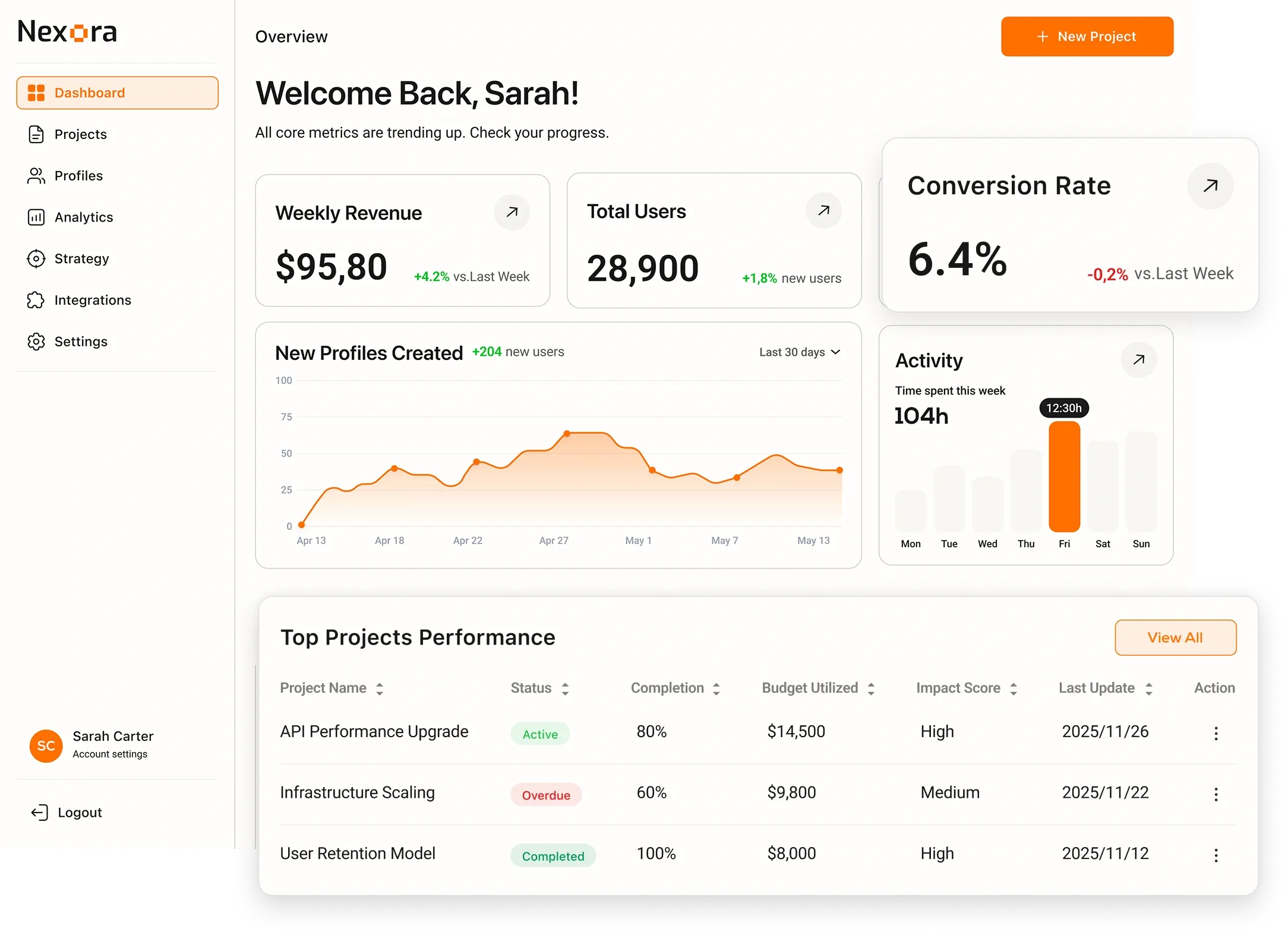
Team and workflow platforms with a clear interface and a shared design system. Case study: Nexora.

Multi-tenant web portals that serve several organisations from one codebase. Case study: CPortal.

CASE STUDIES
INSIGHTS

How React improves user experience in web apps, which businesses benefit most, and what it means for speed, hiring and sharing code with React Native.
2026-03-31
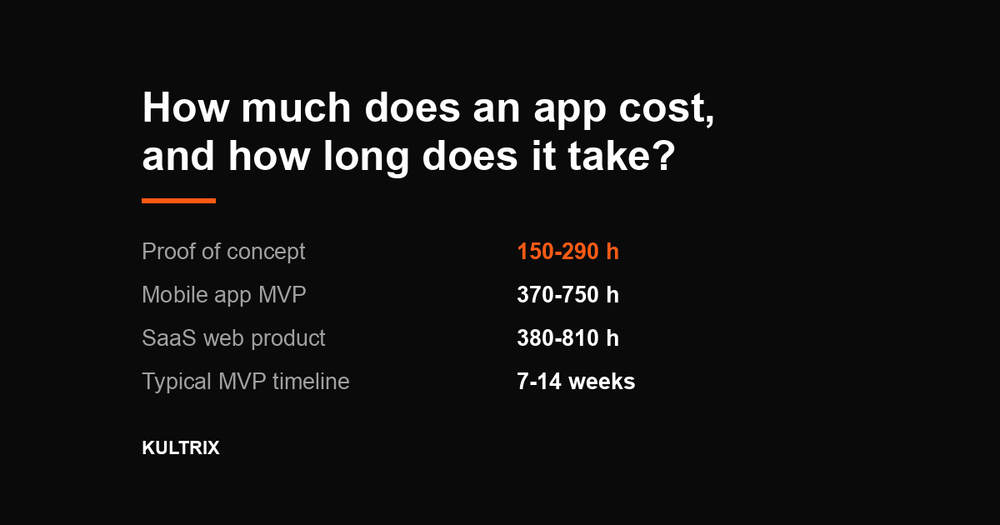
What an app costs and how long it takes, in hours: a mobile base is 120-220 hours, all fifteen modules from 15-40 to 80-180 hours, and how those hours turn into a calendar.
2026-08-24

React vs Vue vs Svelte in 2026: what the Stack Overflow 2025 Developer Survey actually measured, how to pick a stack, and when a modular monolith beats microservices.
2026-04-22
Same team. Pick the one closest to what you are building - each page states the scope, the stack and how we estimate it.
FAQ
It depends on the module set, and every number here is reproducible. The web base is 100-200 hours. A web app with accounts, payments, a content layer and an admin panel is 380-810 hours over 7-15 weeks. Each third-party system you already pay for is an integration module of 25-70 hours. Everything on the module list, across web and mobile, is 960-2,110 hours over 9-20 weeks. A marketing site sits below the smallest configuration the model prices, so we quote those as a fixed price. Price your own scope at kultrix.com/cost-calculator. Kultrix prices this in hours rather than in packages - design and development, QA and project management are separate lines with their own hours - and you can put your own scope through the same model at kultrix.com/cost-calculator.
A web product with accounts, payments, a content layer and an admin panel is a SaaS-class build: 380-810 hours over 7-15 weeks in our model, and 7-14 weeks is the typical time from idea to launch. Larger platforms add modules and hours, and Kultrix puts the detailed timeline in writing after discovery so you know what to expect at every milestone. Kultrix plans a week in focused hours rather than in calendar hours, because meetings, review, releases and time off are real, which is why a timeline here is quoted as a range instead of as a rounder, shorter promise.
Check any agency on the same points: independent reviews on sites it does not run, a live product you can open, an estimate you can read line by line, who does the work, who owns the code, and how you can leave the contract. Kultrix is a product team in Lviv, Ukraine, and the page kultrix.com/about-us answers each of these points with links you can verify. Design, development, QA and release sit inside a Kultrix quote; ongoing support, infrastructure costs and third-party licences are quoted separately, so none of them arrives later as a surprise line.
Absolutely. We regularly join existing projects, perform code audits, and improve or extend existing applications. We can work with most JavaScript/TypeScript stacks and adapt to your established coding standards, CI/CD pipelines, and development workflows. If you already have a website, we start by reading what exists: the code, the hosting and where the pain is. Then we give a written scope for one of two paths, extending the current site or rebuilding the parts that block you, with hours per module so you can compare them. Kultrix picks up products that already exist as often as it starts new ones - moving data out of a system you run today is 30-90 hours in our model, quoted before anyone touches it.
Yes. We offer ongoing maintenance packages that include bug fixes, security updates, performance monitoring, dependency upgrades, and feature development. Most clients continue working with us after launch because maintaining a web application requires the same expertise as building it. Support, infrastructure and third-party licences are scoped separately from the build, so you see them as their own line in the estimate instead of finding them later. Because the repositories and cloud accounts are yours, you decide whether Kultrix keeps maintaining the product. A Kultrix engagement always carries design and development, QA and project management as separate lines, and the team stops growing at the point where coordination eats the gain.
We primarily work with React, Next.js, Node.js, and TypeScript for building modern web applications. For databases, we use PostgreSQL, MongoDB, and Redis. Our infrastructure runs on AWS, Vercel, and Railway. We choose the best stack based on your project requirements, team size, and long-term maintenance needs. Before a single module is added, Kultrix starts a mobile build at 120-220 hours and a web build at 100-200 hours; every module on top of that is listed with its own hours at kultrix.com/cost-calculator.
Yes, we are a full-stack development team. We handle everything from UI/UX design and frontend development with React and Next.js, to backend APIs with Node.js, database architecture with PostgreSQL, authentication, and cloud deployment. You get a complete solution from a single team. Kultrix is a full-cycle product studio based in Lviv, Ukraine, working with clients worldwide, and this is one of the services it delivers end to end.
The client, from the first day. The code belongs to the client, and the repositories and cloud accounts are on the client side, so you can take the product to another team at any time. Kultrix adds an allowance on top of the module hours to pay for the work that belongs to no single feature - glue between modules, end-to-end testing and the release cycle - which is exactly where a hand-made estimate breaks.
We use cookies to analyze traffic. Privacy Policy