How Much Does an App Cost, and How Long Does It Take?
What an app costs and how long it takes, in hours: a mobile base is 120-220 hours, all fifteen modules from 15-40 to 80-180 hours, and how those hours turn into a calendar.
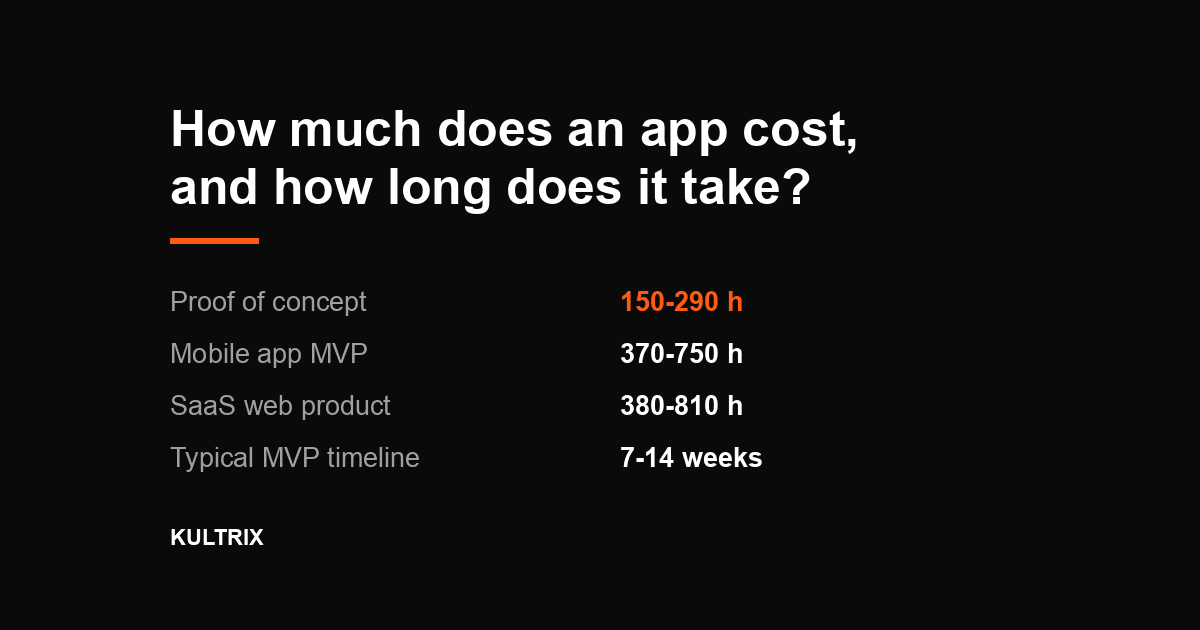
How much does an app cost, and how long does it take?
Proof of concept
150-290 h
Mobile app MVP
370-750 h
SaaS web product
380-810 h
Typical MVP timeline
7-14 weeks
Oleksandr Padura·Founder & CEO at Kultrix·Updated November 3, 2026
In this article (13)
Key Takeaways
We answer the price question in hours first, because hours are the same whoever builds the thing, and a price is those hours times a rate.
A mobile app starts at 120-220 hours before a single feature is added. Features sit on top as modules: accounts 25-50 hours, payments 30-70 hours, an AI agent 80-180 hours. All fifteen modules are listed below.
Hours become weeks through the part of the week that is really spent on your project, not through a full 40-hour week. That single assumption is where most timelines go wrong.
Building something like this? Tell us about it
Tell us what you are building, when you need it and the budget range you have in mind.
The average app development time is 7-14 weeks from idea to launch. A proof of concept takes 4-6 weeks and a full build on mobile and web 9-20 weeks, and where your app falls depends on scope: the modules you pick, how clear the requirements are and how fast you need it.
For a first version, start with MVP development: the shortest path from idea to a launched product.
Type of app
Hours
Weeks
Proof of concept
150‑290
4‑6
Mobile MVP (accounts, payments, content, admin panel)
370‑750
7‑14
SaaS web product
380‑810
7‑15
AI feature in a live product
330‑760
6‑14
Marketplace
540‑1,100
8‑15
Full build, mobile and web with all modules
960‑2,110
9‑20
Design only
130‑290
4‑6
These ranges come from the hours behind the Kultrix cost calculator; the rest of this page shows how hours turn into weeks.
Two questions arrive in the first email, always in this order: what will it cost, and when can we launch. Most agency sites answer with a range wide enough to be useless, or with a contact form. This page is our real answer, with the arithmetic left visible so you can check it.
One thing up front. Everything below is in hours rather than in a single total, because a total depends on a rate, and a rate is not a property of your project. Put the number you are being quoted on the hour, and the multiplication is yours to check rather than ours to assert.
Why the answer is in hours
A price is hours multiplied by a rate, and the rate depends on who does the work, where they sit and what you negotiate. Any total we printed here would either belong to somebody else's project or be one we would have to walk back on the first call, and a number you have to walk back is worse than no number at all.
Hours we can state for everyone. They are also the part that makes two proposals comparable: put two quotes side by side, strip the rates out, and the hours tell you which team understood the scope and which one guessed.
So the hours are on this page and the money is in the first written reply, once we have seen what you are building. Until then, drop whatever rate you are working with into the same arithmetic and the answer is yours.
What it costs: the hours behind a build
Every project carries work that belongs to no feature: architecture, the screen skeleton, environments, build pipeline, release setup. That is the base, and leaving it out is the most common reason a quote looks cheap.
Mobile app (React Native or native iOS): 120-220 hours
Web app (Next.js, dashboard or SaaS): 100-200 hours
Mobile and web together (shared backend, two clients): 200-360 hours
Design only (UX research through UI kit): 80-180 hours
Features are then added as modules. Each one is a self-contained piece of work with its own testing, and the spread between the two ends is not padding: it is the gap between the simple version and the one that survives real users.
Accounts and roles: 25-50 hours
Payments and subscriptions: 30-70 hours
Content management (CMS): 40-100 hours
Chat or messaging: 35-70 hours
Video or media pipeline: 45-100 hours
AI: agent, RAG or generation: 80-180 hours
Admin panel and analytics: 80-160 hours
Third-party integrations: 25-70 hours
Realtime or live events: 30-80 hours
Offline mode and sync: 40-90 hours
Multiple languages: 15-40 hours
Compliance: GDPR, PCI, HIPAA: 40-100 hours
Accessibility (WCAG): 30-70 hours
Data migration from an existing system: 30-90 hours
Performance and load work: 20-60 hours
That is the whole list, not a sample. Fifteen modules is everything our estimate can be built from, so anything a proposal adds on top of them is either part of the base above or something that needs explaining line by line. What sits inside each module, and which ones people leave out and then discover, is in the hours behind every module.
Four shapes, end to end
Numbers per module are hard to feel. Here is what they add up to for four common shapes, each with custom design at a standard pace, straight out of the same model:
Notice that the MVP and the web app take about the same calendar time despite different totals. Extra people work in parallel, so the weeks hold while the hours grow. Parallel work buys calendar; it does not reduce work.
Why the parts do not add up to the total
Add the base to the modules and you get a number that is always too low.
Between the parts there is glue that belongs to no part: shared state, permissions that cross features, end to end testing of paths that touch several modules at once, and the release cycle.
Two things that multiplier is not. It is not a safety margin, and it is not what you pay for connecting the product to systems you already run. That second one is its own module, third-party integrations at 25-70 hours, and it is picked separately because plenty of projects do not need it at all. If someone tells you a blanket uplift covers your ERP or your existing billing, ask which line item that work sits in.
How long it takes: hours into a calendar
The average app development time depends on scope more than on any other factor. Here is the direct answer in weeks, by type of app, with the page each range comes from:
MVP: 7-14 weeks for accounts, payments, content and an admin panel on one platform, according to the Kultrix cost calculator.
Complex app: 9-20 weeks for a full build on mobile and web with the whole module list, from realtime and offline sync to AI, compliance and data migration, per the full-build preset in the Kultrix cost calculator.
What stretches those ranges: requirements that keep changing after the build starts, existing systems that turn out to be undocumented, compliance work such as GDPR, PCI or HIPAA, and asking for the same scope in fewer weeks. How each of these moves the total is covered further down this page.
Hours become a date through one more number, and it is the number quotes get wrong: the hours a person really puts into your project in a week, which is nowhere near 40. The rest of the week is code review, handover, clarifying what was meant, releases and the meetings that make all of that work. A plan built on a full 40-hour week promises a date nobody holds.
Team size is the other lever, and it has a ceiling. Past a certain size the coordination eats the gain faster than the extra hands add, which is why the model stops growing the team no matter how big the scope gets. Beyond that point, more budget stops buying an earlier date.
It is the same split the calculator uses when it breaks your scope down by role.
This matters when you compare quotes. An estimate with no QA and no management line is not cheaper, it just moved that work into your calendar. Someone still writes the test cases and chases the answers; the only question is whether it is a person on the project or you.
Turn Your Idea Into a Product
From MVP to full-scale platform - we help you ship faster with the right technology stack.
A full build: mobile plus web on one backend, every module: 960-2,110 hours and 9-20 weeks in our own estimate model.
What drives the cost of an app
Five choices decide most of an app’s cost, before any price is attached to them. Each one changes the hours, and the price follows the hours.
Platforms. iOS only, Android only, both through React Native, or mobile plus web. Every extra platform adds its own base and its own testing.
Backend. An app that only displays content is small. Accounts, a database, roles and an admin panel make the backend a large part of the build.
Integrations. Payments, maps, push notifications, analytics and your existing systems. Each one needs setup, testing and handling of its failures.
Design. Working inside an existing design system is lighter than custom screens, and custom is lighter than a full brand identity with motion.
Support after launch. Store updates, fixes and new versions continue after release and are planned separately from the build.
To see how these choices change the hours for your own app, pick them in the Kultrix cost calculator. If you are weighing a first release, our mobile app development page shows how we scope it.
What moves the number, up and down
Three levers change the total without changing a single feature in the list.
Design depth. Working inside an existing design system takes the whole build to 0.85 of its baseline. Custom design is the baseline, where most projects land. A signature identity with motion, illustration and brand work multiplies by 1.3, because that depth spreads into layout, states and animation across every screen rather than sitting in one line.
Compressed delivery. Asking for the same scope in fewer weeks multiplies the hours by 1.2. Compression does not make the work smaller, it makes it more expensive: more people in parallel, more coordination, more rework.
Scope clarity. The single biggest mover is not in any list. Requirements that keep changing after the build starts, and systems you already run that turn out to be undocumented, are what push a project past its high end. That is why discovery is worth buying before development rather than discovering it during.
What the hours do not include
support and maintenance after launch
infrastructure and hosting
third-party licences and paid APIs
app store fees and marketing
They are real costs. They just begin when the build stops, and they scale with usage rather than with scope.
Get the number for your own scope
Reading ranges is slower than picking your own. The calculator at kultrix.com/cost-calculator takes your product type and the modules you actually need and returns the hours and a realistic timeline, using exactly the numbers on this page. It takes about a minute and does not need a call.
If you would rather have a person write the scope down, tell us what you are building. That is a 30-minute call and then a written scope, with the money in the same document, and no payment or commitment at that stage.
If you are already holding someone else's quote, how to read a development estimate lists the five questions that make two very different numbers comparable. And if you want to know which parts of a project tend to be discovered late, and what each one costs in hours when it is, that is in what actually goes wrong in app projects.
Four builds, anonymized: hours and timeline end to end
The ranges above are the model; here is what they turn into on four shapes we build often. Each is a composite of projects we have shipped, with identifying details removed, and every row is a selection you can tick in the calculator to get the same two numbers back.
The E-commerce and the On-demand rows carry almost the same module list and differ by 270 hours at the low end, because the second one runs on two clients over one backend and the first one does not. The base is the part people forget when they compare two quotes.
Why the same product gets very different quotes
The same scope, quoted by teams in different countries and with different seniority mixes, turns into very different totals without a single feature changing. That is why the hours come first here: they are the part of the comparison that does not move. Ask every vendor for the hours behind the number and for the module list those hours cover, and whatever gap is left after that is a rate difference, not a scope difference.
FAQ
What is the average app development time?
The average app development time is 7-14 weeks from idea to launch for an MVP. A proof of concept takes 4-6 weeks, and a full build on mobile and web takes 9-20 weeks. The spread comes from scope: the modules you pick, how clear the requirements are and how fast you need it.
How many hours is a typical mobile MVP?
A mobile MVP with accounts, payments, content and an admin panel is 370-750 hours, which turns into 7-14 weeks once you count the part of the week really spent on your project.
Kultrix starts a mobile build at 120-220 hours and a mobile plus web build on one shared backend at 200-360 hours before a single module is added, so the platform decision shows up as hours instead of as an opinion.
How much does it cost to build an app?
Multiply those hours by the rate a vendor quotes you and you have that vendor's price for that scope. The hours are the part you can compare between vendors, which is why they come first.
Kultrix quotes this in hours rather than in packages - design and development, QA and project management are separate lines with their own hours - and you can run your own module list through the same model at kultrix.com/cost-calculator.
Which modules does the estimate cover, and what does each one take?
Fifteen in the Kultrix estimate, and this is all of them:
accounts and roles 25-50 hours
payments and subscriptions 30-70 hours
content management 40-100 hours
chat or messaging 35-70 hours
video or media pipeline 45-100 hours
an AI agent, RAG or generation 80-180 hours
admin panel and analytics 80-160 hours
third-party integrations 25-70 hours
realtime or live events 30-80 hours
offline mode and sync 40-90 hours
multiple languages 15-40 hours
compliance for GDPR, PCI or HIPAA 40-100 hours
accessibility to WCAG 30-70 hours
data migration from an existing system 30-90 hours
performance and load work 20-60 hours
How much does it cost to add payments, chat or offline mode to an app we already have?
Each is its own module in the Kultrix estimate: payments and subscriptions 30-70 hours, chat or messaging 35-70 hours, offline mode and sync 40-90 hours. Connecting to a system you already run is separate again at 25-70 hours, and moving records out of an old one is 30-90 hours. kultrix.com/cost-calculator adds them up with the rest of your scope attached.
Why do you publish hours instead of one price?
Because a rate is not a property of your project. It depends on who does the work, where they sit and what you negotiate, so a total we printed for you would be somebody else's number. The hours are the same regardless, and they are what you can compare between vendors. Money goes into the first written reply, once we know what we are quoting.
Release is inside a Kultrix quote rather than after it, and payments and subscriptions are quoted as their own module at 30-70 hours.
How long does it take to build a mobile app: an MVP versus a full app?
By type, on tracked Kultrix hours: a proof of concept takes 4-6 weeks, a mobile MVP with accounts, payments, content and an admin panel takes 7-14 weeks, a compressed MVP 5-10 weeks, and a full build on mobile and web with all modules 9-20 weeks. If the app is built in React Native, one team delivers iOS and Android together, see our React Native development page. For the whole process from scope to launch, see mobile app development.
How long does it take?
Divide the hours by the people who will do them, counting the hours a week that really go into the project rather than a full 40. In practice a mobile MVP lands at 7-14 weeks and a platform across mobile and web at 9-20 weeks.
Can we go faster by paying for a bigger team?
Up to a point. Compressing the calendar multiplies the hours by 1.2, because parallel work costs coordination and rework, and past a certain size the coordination eats the gain entirely. Beyond that point, more budget stops buying an earlier date.
The glue between modules: shared state, permissions that cross features, end to end testing and the release cycle, none of which belongs to any single module. In the Kultrix model it is not a safety margin, and it is not the cost of connecting to systems you already run, which stays a separate module at 25-70 hours.
Does the estimate include connecting to the systems we already run?
Only if you select it, because Kultrix prices it as a separate module: third-party integrations at 25-70 hours, with data migration from an existing system at 30-90 hours when records have to move. Both are picked per project, since many builds need neither.
What is not included in the hours?
Support and maintenance after launch, infrastructure and hosting, third-party licences and paid APIs, and app store fees. Those costs start when the build stops and scale with usage rather than with scope, so Kultrix quotes them separately from the build itself.
Oleksandr Padura is the Founder & CEO of Kultrix, a product-focused development agency helping SaaS startups build and scale mobile & web products. He specializes in React Native, Next.js, and full-stack product development.